Upravit stránku

Metallized packaging can significantly affect the sensitivity of a conventional metal detector installed downstream of the packaging machine. The inspection therefore often needs to be moved upstream of the packaging process, before the product enters packaging with a metallized layer. However, the correct positioning of the inspection equipment is only one of the factors that determine the reliability of the entire inspection process – from detecting a potentially contaminated product to clearly identifying it and safely rejecting it from the line.

When making an inquiry, it is therefore not enough to simply say: “We want a metal detector.”

We need to know:

  • what is to be inspected,
  • what type of packaging the product will be packed into,
  • what risk the equipment needs to detect,
  • how fast the line operates,
  • where the equipment can be installed,
  • how non-conforming products should be rejected,
  • what data the system should store and transmit further.

In this article, we compare the three most common types of inspection equipment – checkweighers, metal detectors and X-ray inspection systems – as well as equipment that combines checkweighing and metal detection.


Inspection must match the specific risk

An underweight bag, a foreign body in the packaging and a metal fragment from a worn component are three different problems. There is no single universal piece of equipment that would solve all of them equally well.

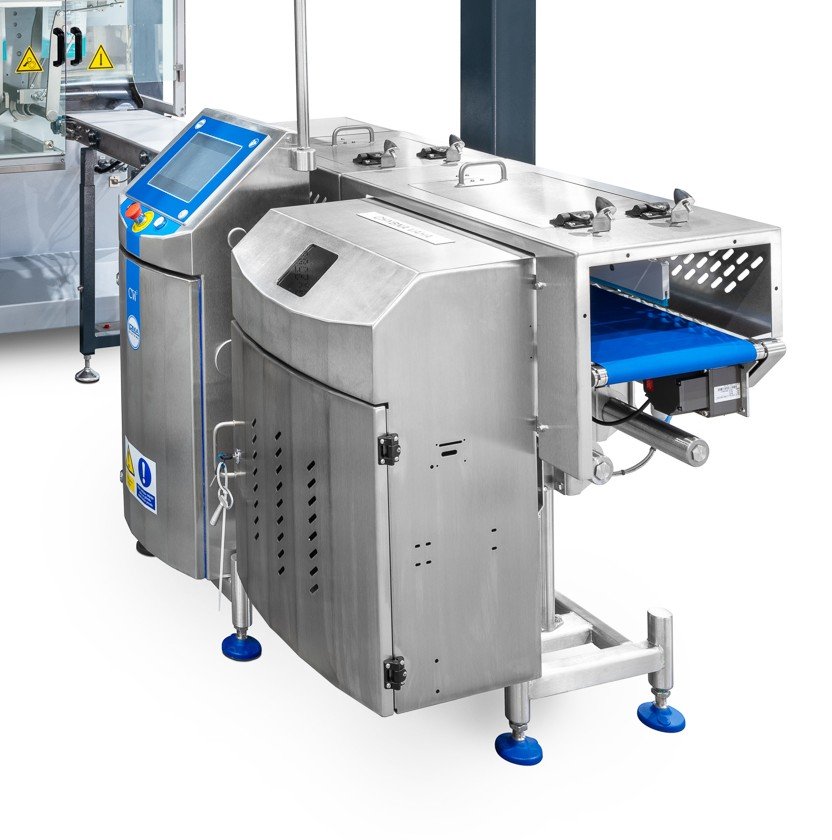
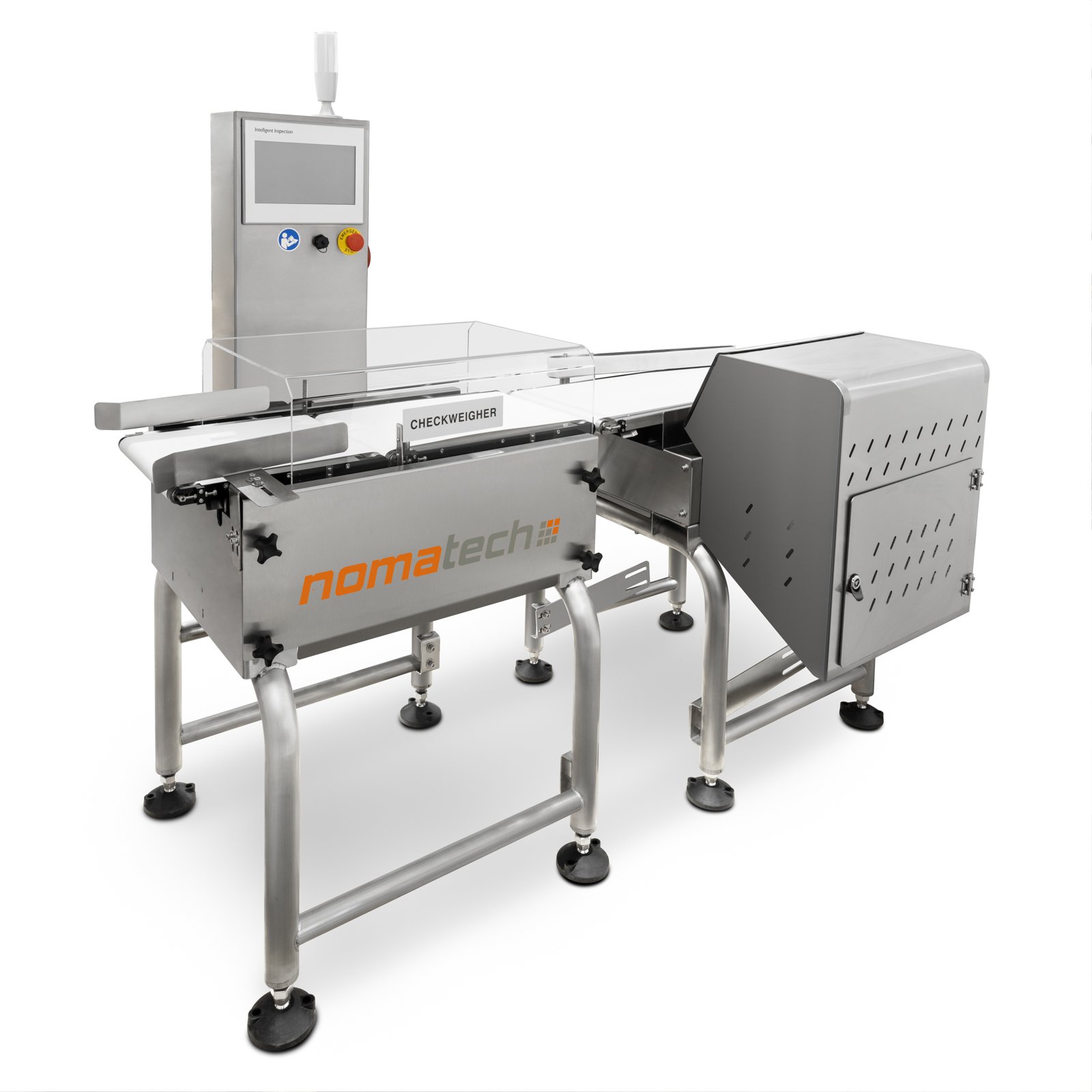
A checkweigher monitors weight. A metal detector searches for metallic contaminants. X-ray inspection can detect a broader range of foreign bodies based on differences in material density and can also inspect the contents of the package.

The choice must therefore be based on an analysis of the specific risk. A bag of spices requires a different type of inspection than a ready meal in an aluminium tray or a bag containing a mix of fasteners.

There are both economic and commercial reasons for this. A single defective package can result in a complaint, a recall of an entire batch from the market or a loss of customer confidence. The requirements of individual customers or retail chains may also include requirements for automatic inspection and documented evidence that the inspection has been carried out.

What each type of equipment can do – and where its limitations lie

DeviceWhat it inspectsLimitations
CheckweigherPackage weight and deviations that are reflected in the final weightCannot detect contaminants or determine the exact arrangement of the contents
Metal detectorFerrous metals, non-ferrous metals and stainless steelThe result is affected by the product, packaging, size and orientation of the metal particle; for some foods, also by the so-called product effect, i.e. the electrical properties of the product itself; does not check weight accuracy
X-ray inspectionMetals and, based on differences in X-ray attenuation, also glass, stone, ceramics, bone and some foreign bodies including certain plasticsCannot automatically detect every material; performance depends on the product, the size and density of the foreign object; does not check correct weight
Checkweigher + metal detectorCorrect package weight and metal contamination at a single inspection stationBoth parts of the equipment must be correctly matched to the product, packaging, line speed and rejection system; does not detect other materials

Checkweigher: when the biggest losses are hidden in grams

“Let’s simply add a few extra grams so we don’t have to deal with complaints.”
This approach is understandable in production. Nobody wants an underweight bag. With more expensive raw materials, however, even a small safety margin can quickly become costly.

Let’s look at a model example:

  • the line produces 80 bags per minute,
  • 2 grams of product are added to each bag,
  • one shift lasts eight hours (480 minutes).

The calculation is simple:
80 bags × 2 g = 160 g per minute | 160 g × 480 minutes = 76.8 kg per shift

If the raw material costs CZK 1,000/kg, for example matcha, nuts, coffee or a premium protein blend, this overfilling represents an additional product cost of CZK 76,800 in a single shift.

This is, of course, a model calculation – it assumes that every bag actually contains 2 g of additional product and that the line runs continuously for the full 8-hour shift.

A checkweigher therefore does not have to serve only to reject underweight or overweight packages. Selected systems continuously monitor the average weight and can provide feedback to the dosing equipment. If the dosing gradually deviates from the target, it can be corrected without waiting for manual intervention. The specific functions always depend on the selected equipment and how it is integrated with the line.

How does a checkweigher work?

The finished package travels along a conveyor through the weighing section. The equipment compares the measured value with the set limits and determines whether the product:

  • can continue further,
  • should be rejected because it is underweight, or
  • should be rejected because it is overweight.

The rejection can be carried out, for example, by an air blast, flap, drop mechanism, pusher or pneumatic rejector. The appropriate method is selected according to the weight, shape and stability of the product.

A checkweigher can also detect a missing item – sometimes

A checkweigher can also monitor package completeness if a missing or additional item has a sufficient impact on the total weight.

We use this principle, for example, at Rollyx, a manufacturer of industrial components. A robust stainless-steel load-cell checkweigher is integrated downstream of the packaging machine.
The system knows the target weight of a correctly filled bag. If, for example, the package is supposed to contain five pieces, the checkweigher verifies that the resulting weight corresponds to this quantity. A bag with a deviation is automatically rejected.

This is an example from a non-food production environment, but the inspection principle is the same: the checkweigher cannot see inside the package, but it can determine from the weight that something is missing or that there is an extra item.

If the difference between individual components is too small or can be hidden within the normal tolerance of the other components, it is advisable to consider another inspection method, such as X-ray or vision inspection, depending on the application.


Metal detector: finding the contaminant is not enough – it must also be safely rejected

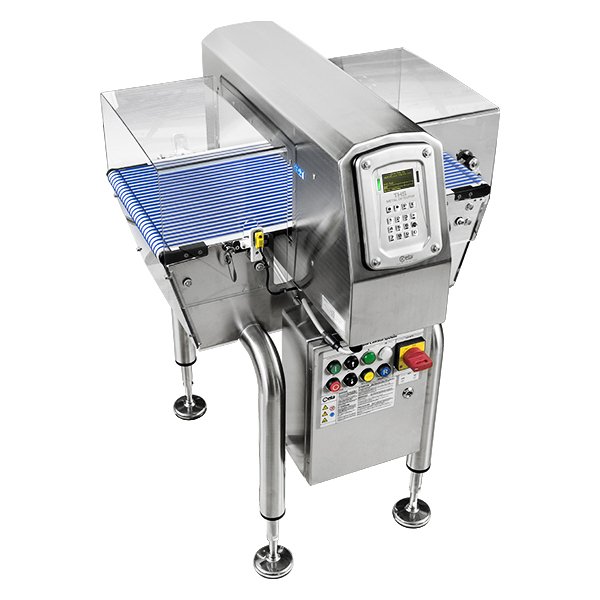
An industrial metal detector creates an electromagnetic field. A metal object affects this field and the equipment evaluates the resulting change.

Depending on the specific design, it can detect:

  • ferrous metals,
  • non-ferrous metals, such as aluminium, copper or brass,
  • stainless steel.

Sensitivity is not a universal value that applies to every product. It is affected by the size and orientation of the particle, product properties, aperture dimensions and packaging material. For food products, the so-called product effect is also an important factor – the electrical conductivity of the product can affect detection sensitivity. It is therefore advisable to test the specific product and packaging before making the final equipment selection.

Conveyor or freefall metal detector?

A conveyor metal detector is generally used for inspecting finished packages or unpackaged products travelling through a detection tunnel on a conveyor.
A gravity-freefall metal detector is installed directly in the flow of bulk product. The product passes through it, for example, between the dosing equipment and the filling tube of a vertical packaging machine.

This positioning upstream of the packaging process is particularly important for products packed into metallized films.

How to detect metal in a product packed in metallized film

Metallized film contains a thin metal layer that can significantly reduce the sensitivity of a conventional metal detector installed downstream of the packaging machine. One solution is to move the inspection upstream of the packaging process: the product passes through a gravity-freefall metal detector before entering the filling tube, and if metal is detected, the affected dose must be clearly identified and safely rejected. The specific identification method depends on the line design and may use product-flow monitoring, timing logic, bag counting or other process-control methods.

This is where the difference between a standalone detector and a properly integrated solution becomes apparent. The detector itself is not enough – the line must know which bag contains the affected dose and ensure that it does not continue to the carton and ultimately to the customer.

Detection and rejection should also be validated as a complete system and subsequently verified on a regular basis. It is therefore not enough to prove that the metal detector can detect metal; it is also necessary to verify that the system reliably separates the contaminated product from the rest of the production when detection occurs.


X-ray inspection: when you need to detect more than metal

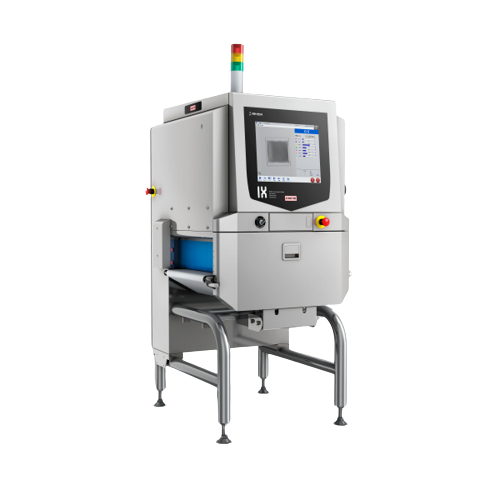
A metal detector addresses metal contamination. If you also need to detect contaminants such as glass, stone, ceramics, bone or certain dense plastics, X-ray inspection may be more suitable.

Food X-ray inspection passes X-rays through the product and evaluates differences in X-ray attenuation (absorption), which are mainly related to material density and thickness. The result therefore depends on how significantly the foreign object differs from the surrounding product.

Depending on the application, X-ray inspection can also check:

  • number of items in the package,
  • missing components,
  • fill level,
  • product shape or damage,
  • presence of a scoop, leaflet, etc.

For these functions, however, it is necessary to distinguish between the capabilities of a specific X-ray system and its actual validated capability for a particular product. Not every configuration can reliably evaluate all of the parameters listed above.

X-ray inspection is not a system that automatically detects every foreign material either. If the unwanted object has a similar density and X-ray absorption to the inspected product, detection may be difficult. The size, position and system settings also matter.

The selection process therefore does not consider only the list of materials that the equipment can theoretically detect. Testing the specific product and packaging is important.

When does X-ray inspection make sense?

X-ray inspection is used particularly when:

  • detecting only metallic contaminants is not sufficient,
  • the product is packed in aluminium or heavily metallized packaging and a gravity-freefall metal detector cannot be installed elsewhere,
  • package completeness or the internal arrangement of the contents needs to be checked,
  • the production process requires a higher level of inspection and documentation.

Industrial X-ray systems are enclosed and shielded. Safety interlocks and other protective elements protect operators from exposure to X-rays. When equipment is properly designed, installed and operated, the radiation dose outside the shielded area is maintained at a safe level.

Food X-ray inspection is also not the same as food irradiation. An X-ray inspection system simply creates an image of the product using X-rays; the food does not become radioactive as a result.


Checkweigher with metal detector: an ideal combination in one system

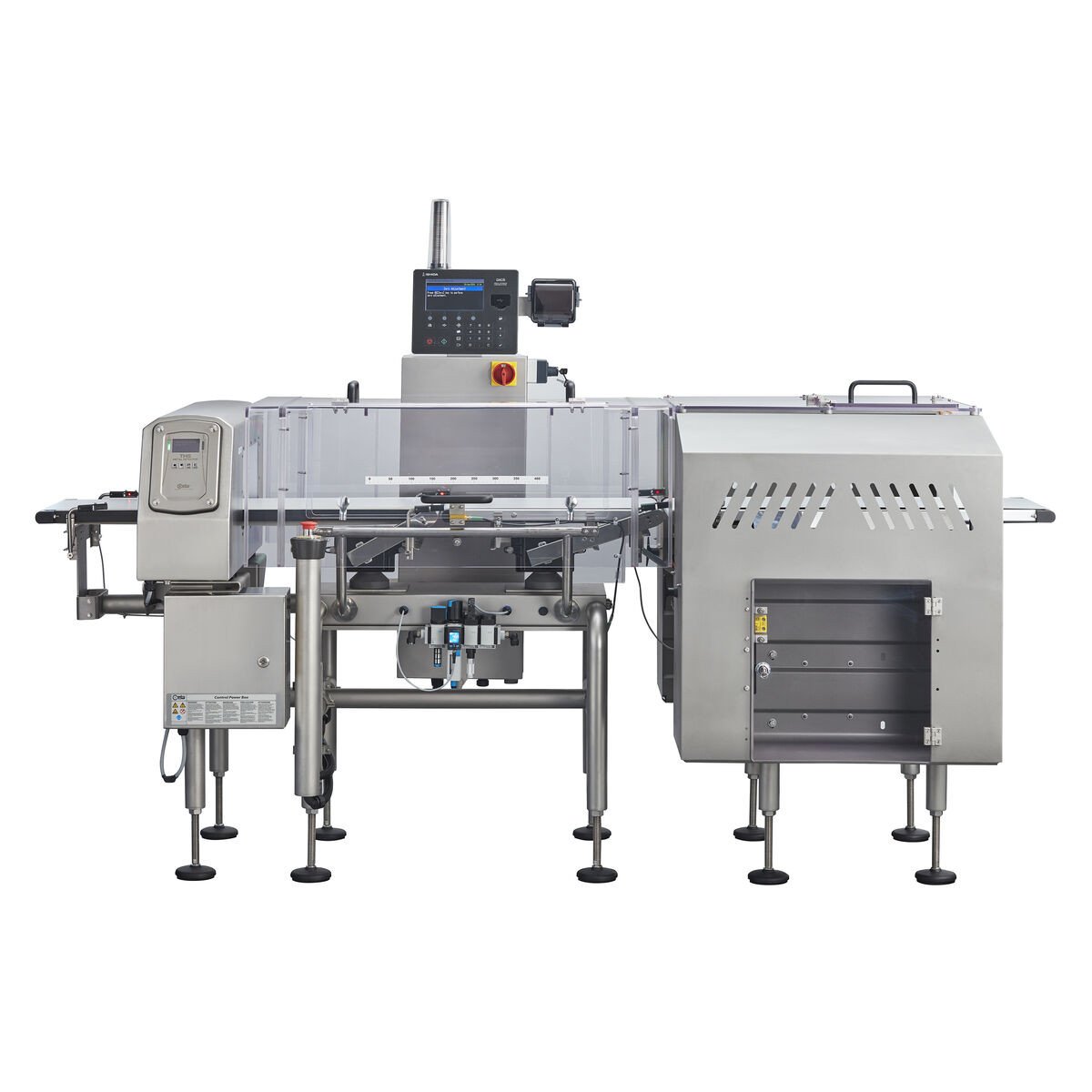
If you need to monitor both weight and metal contamination, the two technologies can be combined in a single system.

A checkweigher with metal detector can offer:

  • one common inspection station in the line,
  • a common user interface,
  • integrated reject control according to the specific configuration,
  • simpler integration with the line control system,
  • unified statistics depending on the selected configuration,
  • lower space requirements than two separate inspection stations.

The actual space saving depends on the selected equipment, conveyor lengths, rejection method and the layout of the entire line.

It is important to emphasize that a combination system does not automatically mean one shared rejection mechanism. The rejection design depends on the specific product, line speed and equipment configuration.

How we integrated a combination system into the claro line

For the Austrian manufacturer of ecological laundry and cleaning products claro, we designed a complete automated line for filling powdered products into tubes and containers.

The checkweigher with metal detector is not a standalone machine added at the end of the project. It is part of an assembly that includes:

  • depalletizing of empty containers,
  • label application,
  • conveying them to the filling station,
  • product dosing,
  • filling,
  • application and closing of lids,
  • checkweighing and metal detection,
  • marking of finished containers.

The entire line also had to address the dust generated by the products being packed. It is therefore enclosed, has prepared extraction points, and the filling heads are lowered deeper into the containers during dosing so that falling powder does not generate dust from a great height.

The inspection section cannot be separated from the rest of the technology. Its performance, communication and rejection method must correspond to the filling rate, container movement and control of the entire line.


Which equipment to use for a specific inspection task

I need to detectMost commonly suitable equipment
Incorrect package weightCheckweigher
A missing item that has a significant effect on weightCheckweigher
Ferrous and non-ferrous contaminants or stainless steelMetal detector
Metal contaminants in a product packed in metallized filmGravity-freefall metal detector upstream of packaging, specialised detection system or X-ray depending on the application
Contaminants made of glass, stone, ceramics, bone or certain dense plasticsX-ray inspection depending on product properties
A missing component that cannot be reliably identified by weightX-ray inspection (or another inspection technology depending on the application)
Weight and metal contaminationCheckweigher with metal detector

The table is intended as a basic guide. The final selection must take into account the specific product, packaging, dimensions, line speed and required sensitivity.


How we select inspection equipment in practice

When designing a solution, we do not start with a catalogue from a particular manufacturer. First, we need to understand the product and the entire packaging process. The key factors include:

  • What the inspection needs to detect – underweight, a metal fragment and a missing component require different technologies; it is important to define the smallest deviation or object that must still be detected.
  • How the product behaves – water and salt content, temperature or a non-homogeneous structure affect sensitivity; the same detector does not perform identically with dry spices and a moist ready meal.
  • What the product is packed in and what the package dimensions are – paper, glass, polyethylene film, a can or metallized film create different requirements and can determine where the inspection needs to be positioned in the packaging line. The length, width and height of the product or package are also important. For a metal detector, these dimensions determine the required detection aperture; for a checkweigher, they affect, for example, the required conveyor width.
  • How fast the line operates – not only the number of items per minute, but also their dimensions, spacing and stability; the inspection system must not create a new bottleneck.
  • What should happen in the event of an error – it must be clear which item is non-conforming, how it will be removed from production, where it will be rejected and how it will be prevented from re-entering the production process.
  • What the operating conditions are – stainless-steel construction, protection rating and cleaning requirements differ between a dry production environment and a line handling meat or sauces.
  • What data is required – OK/NOK quantities, statistics, alarms and test results; depending on the system, these records can provide important evidence that inspection processes are being carried out and verified.
  • How much space is available – a checkweigher needs a stable product path, a metal detector needs the appropriate detection aperture and a metal-free zone (clearance from metal components), and the rejection system needs sufficient space for safe product removal; the layout must be designed in the context of the entire line.

For an initial proposal, it helps if you send us a description or sample of the product, the packaging material and dimensions, package weight, required line output, the risk to be inspected, required sensitivity, production cleaning method, available space and information about the machines to which the inspection system will be connected.


Where to install inspection equipment in the line

A typical arrangement looks like this:

dosing equipment → packaging or filling machine → inspection equipment → labelling or cartoning → palletising

This is not the only option. A gravity-free fall metal detector can be located upstream of the filling tube, a checkweigher often inspects finished packages downstream of the packaging machine, and a conveyor metal detector or X-ray system can be installed on the discharge conveyor. The key is where the specific risk can best be detected and the non-conforming product safely rejected – if the inspection takes place before cartoning, the rejection must be resolved before the products are grouped into a carton.

The positioning of the inspection equipment should be part of the analysis of the entire process. IFS, for example, explicitly requires detectors to be installed in a way that ensures maximum detection effectiveness and prevents subsequent contamination in the next part of the process.

The equipment alone is not enough – it must communicate with the entire line

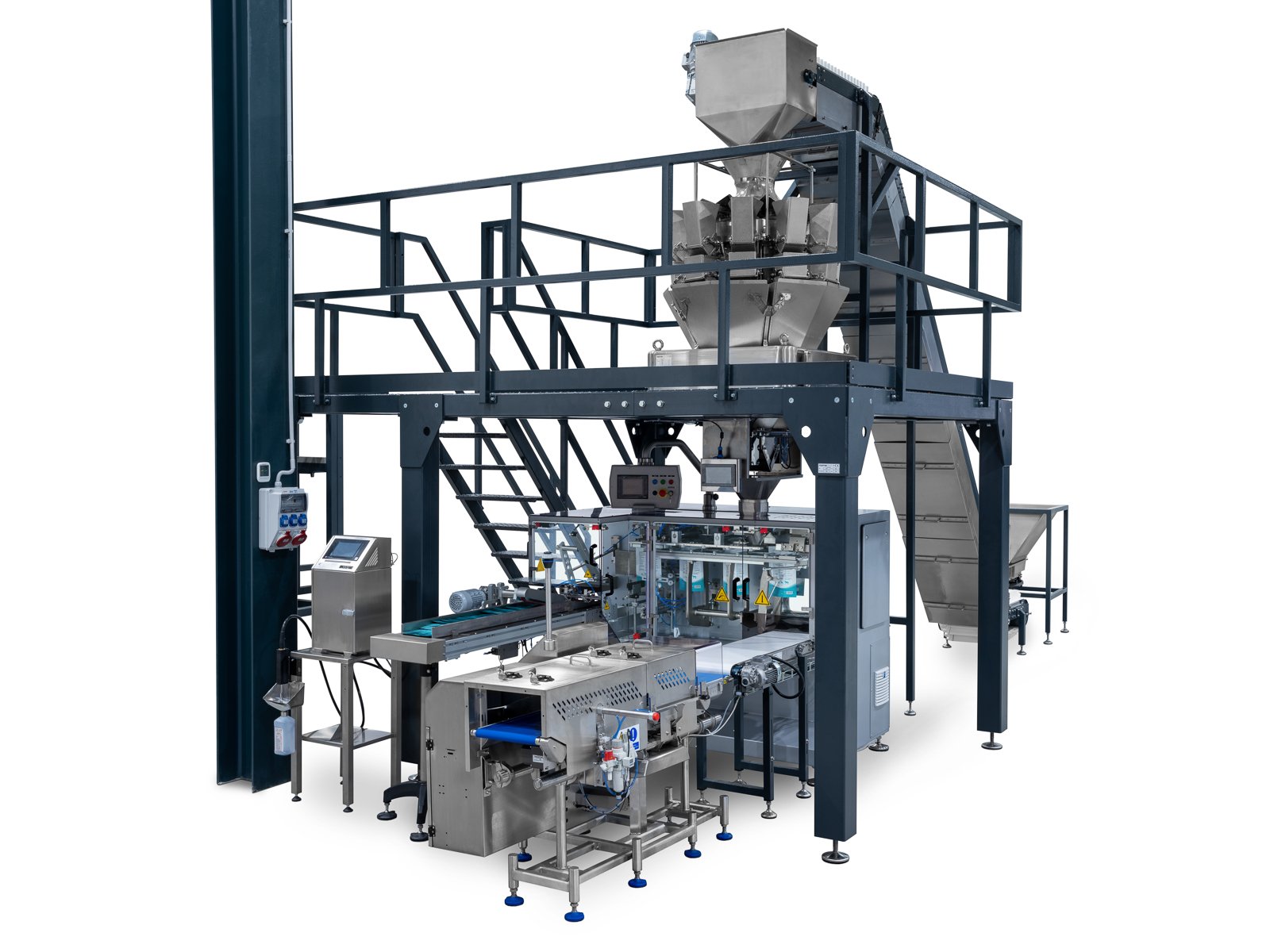
We do not manufacture inspection equipment ourselves – we integrate systems from established, internationally recognised brands such as Ishida, Loma and CEIA into packaging and filling lines. Our role is to ensure that the inspection system works together with dosing, the packaging machine, conveyors, marking, cartoning and palletising, i.e. with the control system of the entire line.

The equipment must receive products at the correct spacing, handle the required throughput, transmit information about errors and trigger the appropriate response from other parts of the line. Integration is often what determines whether inspection functions merely as an isolated device or as a genuine part of the production process.

Additional inspection options

In addition to checkweighers, metal detectors and X-ray systems, there are also vision and laser inspection systems. They are used for specific tasks, such as checking a particular detail of a product or package. Depending on the requirements, a vision system can monitor, for example, the correct position of a particular element or detect a hole in a seal.

These are not standard technologies in NOMATECH's regular portfolio and we do not normally integrate them into our lines. However, if such an inspection is essential for a customer, we assess its possible application and integration individually according to the specific application.

Validation and verification: it is not enough for the equipment to work

With inspection equipment, it is not only important whether it can technically detect a particular problem. It is also necessary to demonstrate that the selected technology is genuinely suitable for the specific product and the required risk.

Validation verifies whether the designed inspection system is capable, under defined conditions, of reliably detecting the required contaminant or deviation. Testing may include the specific product, the size and type of test piece, line speed, packaging and other conditions that can affect the result.

Verification subsequently checks whether the equipment continuously maintains this capability and whether it responds correctly during testing.

The result should be an inspection system for which it can be demonstrated not only that “the detector works”, but that the entire inspection process operates reliably under the conditions of the specific production process.


Do you need to design an inspection system for a specific product?

We will propose suitable inspection equipment and its integration into the complete packaging or filling line.

Send us information about the product, packaging and required line output.

  • Fields marked with an asterisk (*) are required.

FAQ | FREQUENTLY ASKED QUESTIONS

  • What types of inspection equipment are used in the food industry?
    The most common types are checkweighers, metal detectors and X-ray inspection systems. Checkweighing and metal detection can also be combined in a single system.
  • When is a metal detector sufficient and when is X-ray inspection required?
    A metal detector is suitable when metal contamination is the primary risk and neither the product nor the packaging significantly limits its sensitivity. X-ray inspection is used when it is necessary to detect non-metallic foreign bodies as well, inspect the contents of a package or work with packaging that complicates conventional metal detection.
    The choice should be based on a risk analysis and testing of the specific product.
  • Can metal be detected in a product packed in metallized film?
    Yes, but metallized film can significantly reduce the sensitivity of a conventional metal detector installed downstream of the packaging machine. One solution is a gravity-freefall metal detector that inspects the product before it is packaged. Depending on the application, a specialised detection system or X-ray inspection may also be suitable.
  • Can a checkweigher detect a missing or additional item in a package?
    Yes, if the missing or additional item has a sufficient effect on the total weight. If the difference is too small or the specific arrangement of the contents needs to be checked, X-ray inspection may be more suitable.
  • Can X-ray inspection detect every type of plastic or bone?
    No. The result depends on the difference in X-ray attenuation between the foreign object and the product, as well as on the size, position and equipment settings. It is therefore important to test the specific product and the expected contaminants.
  • How is a non-conforming product rejected?
    Depending on the product, an air blast, flap, drop mechanism, pusher or pneumatic rejector can be used. With a gravity-freefall metal detector, the affected dose can be diverted before packaging using a bypass, or the line can clearly identify the bag in which the contaminated dose ended up.
    The specific rejection method must be designed so that the non-conforming product can be reliably separated and prevented from being reintroduced into production.
  • Can inspection equipment help with audits?
    Depending on the selected configuration, systems can store statistics, alarm history, test results and information about rejected products. These records can support the traceability and documentation of inspection processes during internal and external audits.
Author: Petr Houdek, CEO of NOMATECH s.r.o.

RELATED ARTICLES

Checkweighers – accurate weighing, feedback to the dosing system and limiting overfilling. (Coming soon.)

Metal detectors – conveyor and gravity-fed systems, sensitivity and metallized packaging. (Coming soon.)

X-ray inspection – what it can detect, its limitations and when it is worthwhile. (Coming soon.)

Checkweigher with metal detector: when does it make sense to combine two inspections in one system?

Nahoru

This website uses cookies

This website is using cookies to provide services, personalize ads, and monitor traffic. By continuing to use this site you are agreeing with usage of cookies. More information.

Settings

Your privacy is important. You can choose from the cookie settings below. More information.